

Connected Buildings
Smart building solutions for efficiency and automation
Smart City
Technology solutions for enhanced urban living
Public Safety
Critical communication and safety solutions
Connected Transportation
Technology for smarter, safer transport systems
Smart Factory
Advanced technology for optimized manufacturing
Smart AG Poultry
Innovative technology for efficient poultry farming
Zero Trust Security & Private 5G: The Future of Cyber Defense

Dan O'Malley
Expert in 5G

Zero Trust Security is an incredible way to secure any network, including private 5G. It operates on a simple yet convincing premise: trust nothing, verify everything. In this blog, I will explain ins and outs of Zero Trust and its importance to enhance the efficiency of a network.
In short, this security approach is a departure from traditional security models that assume internal networks are safe. Likewise, Zero Trust treats every access request as potentially hostile until proven otherwise. Upon verification, only authorized users and devices can interact with your network.
Private 5G networks offer a dedicated, secure, and high-performance wireless network for organizations. Unlike public 5G, private 5G offers enhanced control, security, and reliability. Combining Zero Trust with private 5G creates a powerful defense against cyber threats.
Table of Contents
ToggleWhat is Zero Trust Security?
As I said, Zero Trust is a security approach that verifies every access request. This cyber security model authenticates and authorizes all access requests regardless of origin before granting access to resources.
It shifts the security paradigm from a perimeter-based approach. Also, it focuses on minimizing damage by strictly controlling access to sensitive information. Zero trust is about building secure ecosystems where trust is never assumed. Instead, trust is only earned through verification.
What is Zero Trust Network Access (ZTNA)?
Zero Trust Network Access (ZTNA) is a technology that enables the implementation of Zero Trust principles. It creates a secure connection between users and the resources they need, regardless of location, device, or network.
ZTNA ensures that users are authenticated and authorized before they can access specific applications or data. It grants least-privilege access based on strict identity verification, device health, and other contextual factors.
More precisely, ZTNA is relevant in today’s remote work environment. It offers a flexible and secure way to connect users to corporate resources without exposing the entire network to possible threats.
History of Zero Trust Security
In April 1994, Stephen Paul Marsh in his doctoral thesis on computed security coined “Zero Trust” for the first time. However, the model gained widespread attention when John Kindervag, an analyst at Forrester Research, officially introduced it in 2010. According to Security Week, Kindervag’s work emphasized the idea that security should not assume that internal network traffic is inherently trustworthy.
Study says, the traditional “castle-and-moat” approach (focused on securing the network perimeter) was increasingly seen as inadequate due to the rise of mobile workforces, cloud computing, and sophisticated cyber threats.
Google further popularized Zero Trust through its “BeyondCorp” initiative. It aimed to secure access to resources based on identity and context rather than location. This initiative demonstrated the practical application of Zero Trust principles and inspired many other organizations to adopt similar strategies.
Around 2017, Gartner introduced the concept of Continuous Adaptive Risk and Trust Assessment (CARTA). It shares similarities with Zero Trust but is focused on continuous assessment and adaptation of security measures.
Then, the National Institute of Standards and Technology (NIST) published Special Publication 800-207 in 2020. It provided a comprehensive framework for Zero Trust Architecture (ZTA). This publication helped standardize the principles and implementation strategies for Zero Trust.
The integration of Zero Trust with modern technologies has been a significant focus. For instance, the concept of Intelligent Zero Trust Architecture (i-ZTA) has been introduced to enhance security in 5G (and 6G in future) networks by leveraging network virtualization and SDN.
The adoption of a phased implementation approach, guided by reference documents such as NIST SP 800-207 and the Department of Defense (DoD) Zero Trust Reference Architecture, has been recommended to ensure a smooth transition to Zero Trust.
The U.S. Government’s Office of Management and Budget mandated the adoption of Zero Trust principles for all federal agencies by 2024. They highlighted the growing importance of this security model.
As a result, major organizations and industries have increasingly adopted Zero Trust. Now, they can meet the demands of modern business environments, protect against advanced threats, and comply with regulatory requirements.
Core Principles of Zero Trust Security – How Zero Trust Works
Zero Trust Architecture (ZTA) operates on a set of major principles to secure digital environments. Let’s explore these core principles according to different sources:
Least Privilege Access
ZTA emphasizes the principle of least privilege. It means that users are granted the minimum level of access necessary to perform their tasks. It reduces the potential impact of unauthorized access or breaches.
For instance, Cloudflare uses this principle through its secure access service edge (SASE) solutions. It provides granular control over who can access what resource within an organization’s network.
Continuous Verification
ZTA needs continuous verification of access for all entities attempting to access resources, regardless of their location relative to the network perimeter. It ensures that every access request is authenticated and authorized based on all available data points.
Assume Breach
Operate under the assumption that a breach has already occurred. This mindset encourages proactive measures to detect and mitigate threats quickly.
Minimize Blast Radius
Minimize the impact of a potential breach by segmenting the network and restricting lateral movement. This way, even if an attacker gains access, they can’t easily move to other parts of the network.
Visibility and Analytics
Comprehensive visibility into network traffic and user behavior is essential for identifying suspicious activities and responding effectively. Many network companies offer deep visibility into endpoint activity to enable rapid detection and response to threats.
Holistic Approach
ZTA should be applied across the entire digital estate. It includes identities, endpoints, networks, data, applications, and infrastructure for comprehensive security coverage.
Automated Context Collection and Response
ZTA should include automation and orchestration tools to rationalize processes and reduce manual errors. They can respond to detected threats, minimize human intervention, and speed up response times.
What Are the Components of Zero Trust?
The components of ZTA enforce the principle of “never trust, always verify” across an organization’s digital ecosystem. These components work together to authenticate, authorize, and continuously validate every user, device, and transaction, regardless of their location relative to the network perimeter.

Identity and Access Management (IAM)
Strong IAM is crucial for verifying the identities of users and devices before granting access. Cloudflare enhances IAM through its Access product. It uses strong authentication methods to ensure that only authorized individuals can access applications and data.
Micro-segmentation
This involves dividing a network into secure zones to contain breaches and limit the lateral movement of threats within the network.
CrowdStrike leverages micro-segmentation in its Falcon platform by applying advanced endpoint protection and response capabilities. It can isolate compromised devices or segments from the rest of the network.
Multi-Factor Authentication (MFA)
MFA adds an extra layer of security by requiring users to provide two or more verification factors to gain access to resources. This significantly reduces the risk of unauthorized access due to compromised credentials.
Policy Engine (PE)
This is the brain of the Zero Trust architecture. It makes decisions about whether to grant or deny access based on policies, user behavior, and other contextual information.
Policy Enforcement Point (PEP)
Zero Trust requires strict enforcement of access policies that consider the risk level of each transaction. Policies must dynamically adapt based on changes in user attributes, device posture, and environmental conditions.
Policy Administrator (PA)
This component establishes and terminates connections between users and resources based on policies set by the Policy Engine. It works closely with the PEP to enforce security rules.
User and Entity Behavior Analytics (UEBA)
UEBA tools analyze patterns of behavior to detect anomalies that could indicate a threat. This helps identify insider threats and compromised accounts.
Endpoint Security
Advanced endpoint protection solutions monitor and protect devices from threats. They ensure that only healthy and compliant devices are allowed to connect to the network.
Encryption
Data encryption protects sensitive information both at rest and in transit. It ensures that even if data is intercepted, it cannot be easily accessed without the decryption key.
Continuous Monitoring and Analytics
Real-time monitoring and analysis of network traffic and user behavior help in detecting anomalies and potential threats. This allows for rapid response and mitigation of risks.
Benefits of Zero Trust
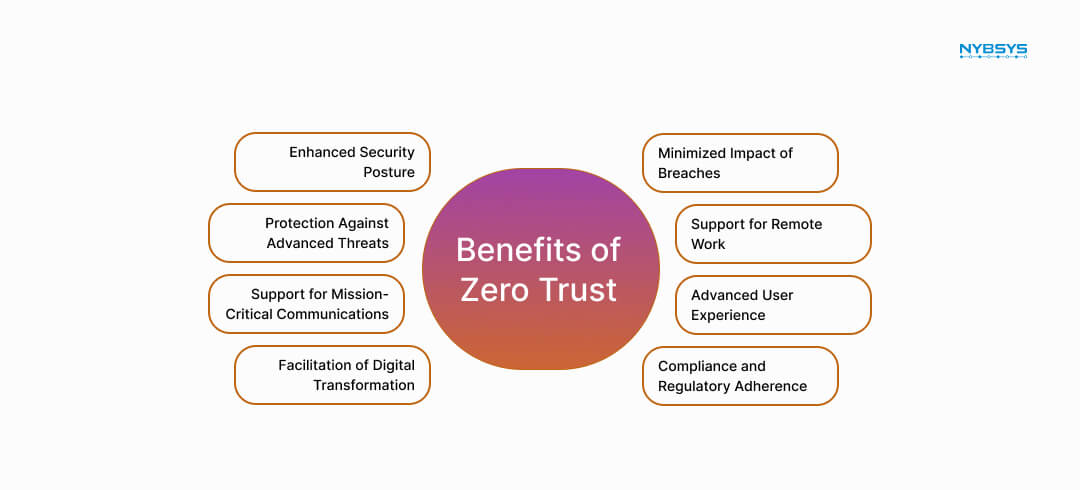
Adopting a Zero Trust model brings numerous benefits to organizations. It provides plenty of advantages:
Enhanced Security Posture
ZTA reinforces network security (especially for 4G and 5G) by ensuring that no internal or external entity is trusted by default. This approach protects the confidentiality, integrity, and availability of the network.
Protection Against Advanced Threats
Zero Trust security mitigates risks from advanced persistent threats and other cyberattacks by minimizing the possible entry points for attackers. It also continuously verifies and authenticates users and devices to make a robust security framework for 5G networks.
Support for Mission-Critical Communications
Zero trust is particularly beneficial for mission-critical communications and tactical edge networks. These are essential for both economic and military advantages. Note that this support is important for different security organizations, including the government and NGOs.
Facilitation of Digital Transformation
If you implement ZTA in your business, it will provide support for smoother and more efficient digital transformation. You will get a clear strategy for securing users, applications, and infrastructure in cloud and SDN-based environments.
Minimized Impact of Breaches
Even if there is any breach, Zero Trust limits the spread of this attack using the micro-segmentation method. The attacker remains confined to a small segment of the network, which reduces overall damage.
Support for Remote Work
Employees can surely access their desired network from anywhere worldwide, any device for the Zero Trust security model.
Advanced User Experience
Zero trust implements least privilege access and context-aware policies. So users get access to the resources they need. But they do not face any unnecessary hurdles.
Compliance and Regulatory Adherence
Zero Trust helps communication service providers (CSPs) or mobile network operators (MNOs) comply with industry-specific regulations regarding data protection and user privacy. It enhances their overall security posture.
Integration of Zero Trust in 5G
The integration of Zero Trust (ZT) principles into 5G networks is critical due to the untrusted components and the need for enhanced security. It requires a strategic and phased approach for a smooth transition and minimal disruption to business operations.
The concept of an intelligent zero trust architecture (i-ZTA) is introduced as a security framework for 5G/6G networks. i-ZTA leverages network virtualization, software-defined networking (SDN), and service-based architecture (SBA).
i-ZTA adopts an SBA-based design to ensure ease of integration, like the 3GPP specification of 5G networks. This design includes the open radio access network (ORAN) architecture with proper real-time engines and network interfaces. They collect necessary machine learning data.
A hybrid approach combining Defense in Depth and ZTA is proposed to provide consistent protection for 5G applications. It aims to ease risks inside the network perimeter. Similarly, the phased implementation approach is guided by reference docs such as NIST Special Publication 800-207 and the Department of Defense (DoD) ZTA.
If you want to implement Zero Trust architecture, you can follow these key steps:
- Assessment: Start with a full assessment of your current IT environment, including networks, devices, applications, and data flows.
- Design: Design your ZTA by considering the integration of existing systems and the introduction of new technologies like multi-factor authentication (MFA), micro-segmentation, and encryption.
- Integration: Integrate components with existing infrastructure, which involves upgrading legacy systems or replacing them with compatible solutions.
- Policy Enforcement: Implement strict access controls and enforce security policies across the organization. Use automation tools to streamline policy management and ensure consistent enforcement.
- Continuous Monitoring and Improvement: Establish continuous monitoring and analytics to detect anomalies and potential threats. Regularly review and update security policies based on new threats and changes in the IT environment.
Frequently Asked Questions
Zero trust is a cybersecurity model that operates on the principle of “never trust, always verify.” It assumes that no entity inside or outside the network is trustworthy by default and requires all users, devices, and transactions to be authenticated and authorized before granting access to resources.
It provides a secure framework for remote workforces by ensuring that only authenticated and authorized users can access company resources, regardless of their physical location. This reduces the risk of data breaches and supports the secure remote access needs of modern workforces.
Organizations must define their attack surface, implement controls around network traffic, architect a Zero Trust network, create a policy, and continuously monitor their network.
Nybsys – We Provide Solutions to Zero Trust Security Adoption
The journey toward implementing Zero Trust Architecture is not just about adding layers of security. Well, it is about fundamentally changing how organizations view and manage their security posture. You can significantly increase network security, improve monitoring capabilities, and enhance overall security resilience.
However, implementing ZTA requires a thoughtful, strategic implementation that aligns with your organization’s needs and goals. And this is where we, Nybsys, are the top choice to get the best assistance regarding Zero Trust security.
We offer products and services that follow the standards of the ZTA security model. Any radio access network (RAN) and other products you get from us are already designed with this model. These devices only provide access to permitted entities.
Nybsys believes that ZTA security can drive digital transformation across all industries. If your business is preparing for 5G adoption, contact us soon to implement Zero Trust security in your private 5G networks.
Thank you for reading this blog.